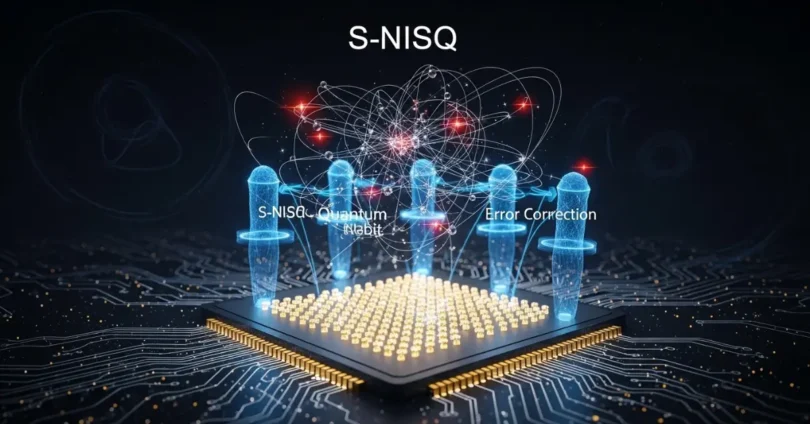
Quantum computers are powerful machines, but they are very sensitive to mistakes. That is why S-NISQ quantum error correction is becoming so important. This method helps protect the most important parts of a quantum computer from errors without needing too many extra resources. With S-NISQ, researchers can get more accurate results from today is quantum machines, even though full error correction is still too expensive or complex.
What Is S-NISQ Quantum Error Correction?
S-NISQ quantum error correction is a smart way to reduce errors in quantum computers. Quantum computers use tiny units called qubits, which can easily lose information due to noise or interference. S-NISQ focuses on protecting the qubits that matter the most, so the results become more reliable. Unlike full error correction, S-NISQ uses fewer extra qubits and simpler methods, making it perfect for today’s machines.
Why Quantum Computers Make Mistakes
Quantum computers are very delicate. Even small disturbances can cause mistakes. Some common reasons for errors include:
- Heat and outside disturbance: Qubits can be affected by the environment.
- Weak qubit stability: Some qubits lose information faster than others.
- Reading mistakes: Measuring a qubit can sometimes give the wrong result.
- Gate operation mistakes: The operations performed on qubits are not always perfect.
Because of these issues, even a tiny error can ruin the entire calculation, which is why error correction is needed.
What Does “NISQ” Mean in Quantum Computing?
NISQ stands for Noisy Intermediate-Scale Quantum. These are the quantum computers we have today. They are powerful, but still limited and noisy. NISQ machines cannot run full error correction because it would require too many qubits and resources. That’s why S-NISQ was created as a practical solution for today’s quantum computers.
How S-NISQ Is Different from Normal Quantum Error Correction
Full quantum error correction tries to fix all mistakes, but it is very expensive and requires many extra qubits. On the other hand, S-NISQ quantum error correction focuses only on the most important errors. It protects key qubits and operations without adding too much complexity. This makes it a “middle path” — not perfect, but very useful for near-term quantum computers.
The Main Idea Behind S-NISQ Quantum Error Correction
The main idea of S-NISQ is selective protection:
- It does not fix every error.
- It focuses on the most harmful errors first.
- It uses fewer extra qubits and simpler methods.
- It improves results while keeping the quantum circuit short and manageable.
This smart approach allows researchers to get better results without waiting for full fault-tolerant quantum computers.
Key Parts of an S-NISQ System
Some Parts of S-NISQ System:
1. Selective Qubit Protection
Only the most important qubits get extra protection, which saves resources.
2. Smart Circuit Design
Quantum circuits are built shorter and simpler to reduce errors.
3. Noise-Aware Mapping
Tasks are sent to the more stable qubits, avoiding weak hardware areas.
4. Lightweight Error Detection
Common errors are spotted quickly without heavy correction.
5. Fast Classical Support
Classical computers help reduce errors and improve results.
How S-NISQ Quantum Error Correction Works Step by Step
Some Steps of S-NISQ Quantum Error Correction;
1: Prepare the Quantum Circuit
Design the task you want the quantum computer to perform.
2: Identify Risky Parts
Find the qubits that are most likely to have errors.
3: Protect Important Qubits
Apply extra safety only where it matters most.
4: Reduce Noisy Operations
Simplify or remove steps that can cause mistakes.
5: Run the Circuit
Execute the quantum operations on the machine.
6: Check the Output
Look for incorrect or unstable results.
7: Improve the Final Answer
Use smart correction or mitigation methods to make results more reliable.
Common Error Types S-NISQ Tries to Handle
Some Error of S-NISQ:
- Bit-flip errors: A qubit flips from 0 to 1 or vice versa.
- Phase-flip errors: The phase of a qubit changes incorrectly.
- Measurement errors: Reading a qubit gives the wrong value.
- Gate errors: Operations on qubits are imperfect.
- Decoherence: Qubits lose information over time.
S-NISQ vs Error Mitigation: Are They the Same?
- Error Mitigation: Reduces the effect of errors without actually correcting them.
- Error Correction (S-NISQ): Fixes errors in selected parts of the circuit.
S-NISQ sometimes uses ideas from error mitigation, but it is focused on protection and correction, not just reducing the impact.
Real Benefits of S-NISQ Quantum Error Correction
Some Benefits of S-NISQ Quantum Error Correction:
- Produces more accurate results on noisy machines.
- Uses fewer resources than full error correction.
- Makes quantum experiments more practical today.
- Easier to implement on current quantum hardware.
- Helps researchers learn and improve for future machines.
Biggest Challenges of S-NISQ Systems
Some Challenges of S-NISQ Systems:
- Cannot fix all errors only some are corrected.
- Hardware is still fragile.
- Scaling to bigger systems is difficult.
- Some tasks may still fail.
- Full fault-tolerant machines are still the ultimate goal.
Where S-NISQ Quantum Error Correction Can Be Used
Quantum Chemistry
Simulate molecules more accurately.
Material Science
Study new materials and chemicals.
Optimization Problems
Solve complex decision-making problems.
Quantum Machine Learning
Improve smart quantum models.
Research Labs
Test quantum algorithms with today’s machines.
Simple Example of S-NISQ in Action
Imagine a quantum circuit with 5 qubits. Two qubits are noisy. S-NISQ protects only the important ones, reducing errors. When the task runs, the final result is more reliable than without S-NISQ.
S-NISQ Quantum Error Correction vs the Future
S-NISQ is not the final solution, but it is very useful today. It helps researchers work with current machines and prepares them for full fault-tolerant quantum computing in the future. It is a smart, practical step toward better quantum results.
Common FAQs About S-NISQ Quantum Error Correction
Faqs of S-NISQ Quantum Error Correction:
Is S-NISQ quantum error correction the same as full quantum error correction?
No. S-NISQ only protects the most important qubits.
Why do quantum computers need error correction?
Because qubits are fragile and errors can ruin results.
Can S-NISQ work on today is quantum computers?
Yes, it is designed for current NISQ machines.
What kind of errors does S-NISQ try to reduce?
Bit-flip, phase-flip, gate errors, measurement errors, and decoherence.
Is S-NISQ better than error mitigation?
It is different. S-NISQ corrects selected errors, while mitigation only reduces their effect.
Does S-NISQ need extra qubits?
Yes, but fewer than full quantum error correction.
Why is full quantum error correction hard?
It requires many extra qubits and complex operations.
What is the future of S-NISQ quantum error correction?
It helps researchers today and prepares for full fault-tolerant quantum computers.
Conclusion
S-NISQ quantum error correction is a clever way to handle errors in today is quantum computers. It protects the most important parts, improves results, and uses fewer resources. While it cannot fix everything, it is a practical solution for near-term quantum machines and a step forward toward the future of quantum computing.