
The modern digital landscape is designed to be loud. Between the constant ping of Discord notifications, the allure of 4K open-world gaming, and the relentless stream of academic emails, our “mental real estate” is under constant siege. Most people don’t lose time in large chunks; they lose it in “micro-leaks”—the five minutes spent checking a feed that turns into forty minutes of mindless scrolling. To reclaim ten hours every week, you don’t need more willpower; you need a better system for managing your cognitive load.
Achieving peak performance in 2026 requires a shift toward digital minimalism. When your schedule becomes mathematically impossible to manage, the most successful individuals look for ways to delegate low-impact tasks. For instance, many students realize that the most efficient way to protect their “Brain Wealth” is to strategically pay someone to write my assignment via MyAssignmentHelp, effectively buying back hours of deep-focus time. By offloading the mechanical burden of documentation, you create the mental “white space” necessary for high-level skill development and analogue recovery.
The Science of Cognitive Load and “Brain Wealth”
To understand where your ten hours go, you have to understand Cognitive Load Theory. Your brain has a limited amount of processing power, much like a CPU. Every open tab, unread notification, and looming deadline acts as a background process that slows down your primary “operating system.” In the tech and gaming world, we obsess over reducing latency and fixing controller drift with TMR sensors to ensure every input is precise. Your brain requires the same level of maintenance. When you are overwhelmed by “extraneous load”—the unnecessary mental effort spent on disorganized tasks—your ability to focus on complex problem-solving evaporates.
Reclaiming your time starts with identifying these background processes and “killing the task” before it drains your battery. In 2026, the concept of “Brain Wealth” has emerged as a key metric for success. This isn’t just about how much you know, but how much mental energy you have available at any given moment. When you spend your morning fighting with a complex software update or trying to decipher vague assignment prompts, you are spending your Brain Wealth on things that don’t offer a high return on investment.
Auditing the “Micro-Leaks” in Your Schedule
Most of us believe we are productive because we are busy. However, busyness is often just a defense mechanism against deep work. To find your ten hours, you must perform a “Time Audit.” For three days, track your transitions. You’ll likely find that the transition from “study mode” to “gaming mode” is where the most time is lost. This is often called “Transition Friction.”
Before we move into technical optimization, we must address the structural bottlenecks in academic writing. A common time-sink is the technical formatting required for research papers. Learning how to write an APA abstract is a vital skill for any student, but when you are under a tight deadline, these technicalities can eat into the time you should be spending on actual learning. By mastering these small structural elements early, or using myassignmenthelp to ensure your formatting is flawless, you remove the friction that usually leads to procrastination.
1. Implement “Focus Modes” and Hardware Filters
Modern consoles and smartphones now come with advanced Focus Modes, but few people use them to their full potential. To reclaim your first three hours, you need to treat your attention like a finite resource.
- Hardware-Level Blocking: Use a router-level setting to block non-essential sites during “Deep Work” hours. This prevents the “just one quick check” habit from ever starting.
- The Greyscale Hack: Turn your phone screen to greyscale. This makes the colorful icons of social media less neurologically rewarding, naturally reducing the dopamine hits that keep you scrolling.
- Peripherals Matter: Just as a high-quality mechanical keyboard improves typing speed, a dedicated “focus space” with zero distractions cues your brain to enter a flow state faster.
| Productivity Tool | Function | Estimated Time Saved |
| App Blockers | Prevents social media access during study blocks | 2.5 Hours/Week |
| Noise-Canceling Gear | Eliminates auditory distractions in dorms | 1.5 Hours/Week |
| TMR Sensor Controllers | Reduces frustration/drift during gaming breaks | 0.5 Hours/Week |
| Academic Templates | Pre-formatted styles for APA/MLA reports | 2.0 Hours/Week |
2. The Power of Strategic Delegation
You cannot do everything at an elite level. The highest-performing individuals in any field—whether esports or engineering—understand the concept of “Opportunity Cost.” If you spend five hours struggling with a bibliography or a repetitive essay draft, that is five hours you haven’t spent practicing your core craft.
Delegation isn’t about laziness; it’s about resource allocation. By utilizing specialized services to handle the “bottleneck” tasks, you ensure that your energy is reserved for the 20% of work that produces 80% of your results. This is how you “patch” your schedule to prevent burnout and keep your GPA and your gaming rank in the green. Think of it as outsourcing your “Extraneous Load” so you can focus on “Germane Load”—the actual learning and creation that matters.
The Focus Funnel Diagram:
- Eliminate: Tasks that don’t need to be done.
- Automate: Tasks that can be handled by software.
- Delegate: Tasks that require a human but not your specific expertise (e.g., proofreading).
- Focus: The high-value work only you can do.
3. Mastering the “Analogue Reset”
To maintain a high frame rate in your daily life, you need to clear your cache. An analogue reset is a period of time where you are completely disconnected from digital inputs. Constant stimulation leads to “attention residue,” where thoughts of your last game or a recent social media comment bleed into your study time.
- The 30-Minute Buffer: Spend the first 30 minutes of your day without looking at a screen. This prevents your brain from starting the day in a “reactive” state.
- The “One-In, One-Out” Rule: For every hour of high-intensity digital stimulation (like competitive gaming or coding), spend fifteen minutes in an analogue hobby—reading a physical book, walking, or even just sitting in silence.
4. Optimize Your Academic Workflow
The final piece of the puzzle is streamlining how you handle information. If you spend hours searching for sources or trying to figure out how to structure a thesis, you are wasting valuable focus.
- Template Everything: Create a “Master Document” for your assignments that already includes your headers, font styles, and citation formats.
- Use AI for Outlining, Not Thinking: Use tools to help you organize your thoughts, but keep the core analysis human. This ensures “Information Gain” and keeps you from falling into the trap of generic, low-ranking content.
- Batch Your Tasks: Never write one email at a time. Set two 15-minute windows per day to handle all communications. This protects your “Deep Work” blocks from being fragmented by minor pings.
5. Managing Physical Fatigue for Mental Clarity
We often forget that focus is a biological process. If you are physically drained, no amount of time management will help. This is particularly true for students who balance late-night gaming with early-morning lectures.
- Hydration and Latency: Dehydration increases your reaction time—both in-game and in-class. Treat your body like high-end hardware; it needs the right fuel to stay cool under pressure.
- The 20-20-20 Rule: Every 20 minutes, look at something 20 feet away for 20 seconds. This reduces digital eye strain, which is a major contributor to evening focus fatigue.
Why “Brain Wealth” is Your Most Valuable Asset
In 2026, the most successful people aren’t those who work the most hours; they are those who protect their attention the most fiercely. Your Brain Wealth is the total sum of your mental energy, focus, and creative capacity. Every time you reclaim an hour from a mindless digital habit or a repetitive academic task, you are making a deposit into that account.
If you are constantly overdrawn, you’ll find yourself making mistakes in your code, missing citations in your essays, and losing matches because your reaction speed has slowed. By combining the principles of Digital Minimalism with strategic tools—whether that’s high-performance TMR sensor gear for your setup for your studies—you create a lifestyle that is sustainable and high-performing.
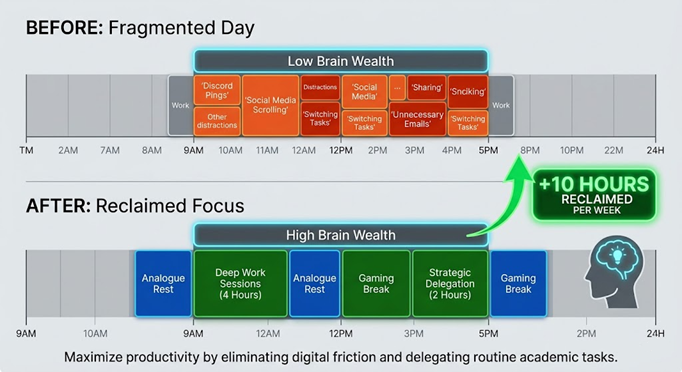
Final Summary Checklist: Reclaim Your 10 Hours
| Category | Specific Action | Impact |
| Tech | Enable “Greyscale” and “Focus Modes” | 3 Hours Saved |
| Strategy | Delegate repetitive academic drafts | 4 Hours Saved |
| Routine | Implement a 30-minute analogue morning | 2 Hours Saved |
| Workflow | Batch all emails and messages | 1 Hour Saved |
The goal isn’t just to be more productive; it’s to have the freedom to enjoy your life without the constant weight of “to-do” lists hanging over your head. Start small. Reclaim one hour tomorrow by turning off all non-human notifications. Then, use the momentum to take back the rest of your week. Your focus is the only thing you truly own—don’t let the digital noise take it from you.
Frequently Asked Question
What is the most effective way to identify time leaks in a daily schedule?
The most reliable method is a three-day time audit. By tracking the exact moments you transition between tasks, you can pinpoint “micro-leaks”—small gaps where digital distractions turn into significant periods of lost productivity.
How does digital minimalism improve mental performance?
Digital minimalism reduces the “attention residue” caused by constant notifications. By simplifying your digital environment, you lower your brain’s background processing load, which increases the mental energy available for deep focus and complex problem-solving.
What is the benefit of an analogue morning routine?
Avoiding screens for the first 30 minutes of the day prevents your brain from entering a reactive state. This buffer allows you to set your own priorities for the day before external inputs like emails or social media dictate your mood and focus.
How can strategic delegation prevent academic burnout?
Delegation allows you to offload repetitive or mechanical tasks that don’t contribute to your core learning. By focusing your energy only on high-value work, you maintain a sustainable pace and preserve the mental clarity needed for long-term success.